Nano Particle Analyzer
HORIBA SZ-100
The new, compact nano particle analyzer HORIBA SZ-100 is designed for particle size measurement down to the nano range as well as for the determination of zeta potential and molecular weight.
The SZ-100 measures ultrafine particles down to the nanometer range in extremely low as well as in extremely high sample concentrations. This newly developed analyzer is used in the fields of bio and nano technology (e.g. nano ceramics, nano metals) and for protein analyses. The HORIBA SZ-100 provides the best measurement results and features a wide measurement range from 0.3 nm to 8 microns. Therefore the instrument not only meets the requirements of modern laboratories but also the quality control needs at production facilities.
Particle Size Measurement from 0.3 nm to 8 µm
The SZ-100 measures the particle size distribution over a wide measurement range using photon correlation spectroscopy (PCS). Analyses are possible across a wide range of sample concentrations: from low ppm-order concentrations to high-concentration samples in double-digit percentages. Disposable standard plastic cells or glass cuvettes can be used for analysis. The required sample volume ranges between 12 µl and 3 ml.
Measurement of Zeta Potential from -200 to + 200 mV
Analysis of sample volumes as small as 100μL using HORIBA-developed microelectrophoresis cells.
Determination of the Molecular Weight from 1 x 10³ bis 2 x 10⁷ g/mol
Absolute molecular weight (Mw) and the second virial coefficient (A2) are obtained by performing static light scattering measurement while changing sample concentration and preparing Debye plots.
Application Examples
Product Advantages
- Extremely wide measurement range from 0.3 nm - 8 µm
- Highest resolution and precision
- Compact design allows for installation in any laboratory environment
- Samples ranging from low ppm-order concentrations to 40 Vol%
- Flexible optics with measurements at 90° or 173°
- Temperature-controlled measurement chamber
- Easy operation, no cleaning or maintenance required
- Measurement of zeta potential
- Determination of molecular weight and 2. virial coefficient
- Rapid analysis (2 min)
- Simple, intuitive software, 21CFR Part11 conformity (option)
Features
| Measuring principle | |
| - Particle size | Photon Correlation Spectroscopy |
| - Molecular weight | Debye plot method (static light scattering) |
| - Zeta potential | Laser Doppler electrophoresis |
| Measuring range | |
| - Particle size | 0.3 nm - 8 µm |
| - Molecular weight | 1 x 10^3 - 2x 10^7 g/mol |
| - Zeta potential | -200 mV to +200 mv |
| Accuracy of particle size measurement | measurement accuracy +/-2% for NIST traceable polysterene latex 100 nm particle |
| Measuring time | ~2 min under ordinary conditions |
| Required sample volume | |
| - Particle size | minimum volume of 12 µl - 1.2 ml (depending on cell material) |
| - Molecular weight | minimum volume of 12 µl - 1.2 ml (depending on cell material) |
| - Zeta potential | 100 µl |
| Dispersion liquid | water, alcohol and other organic solvents (subject to the used cuvette) |
| Optical system | |
| - Light Source | semiconductor laser excitation solid laser (532 nm, 10 mW) |
| - Detector | photomultiplier tubes (PMT) |
| Measuring cell | |
| - Particle size | cuvettes |
| - Molecular weight | cuvettes |
| - Zeta potential | dedicated cells with electrodes |
| Laser-type | class 1 |
| Temperature setting for samples | 1 °C - 90 °C (up to 70 °C for cells with electrodes and plastic cells) |
| Operating environment | 15 °C - 30 °C, less than 85% rel. humidity (no condensation) |
| Power supply | 100-240 V, 50/60 Hz |
| Dimensions (W x H x D) | 528 x 273 x 385 mm (excluding protrusions) |
| Weight (Measuring unit) | 25 kg |
| Interface | USB 2.0 (between PC and analyzer) |
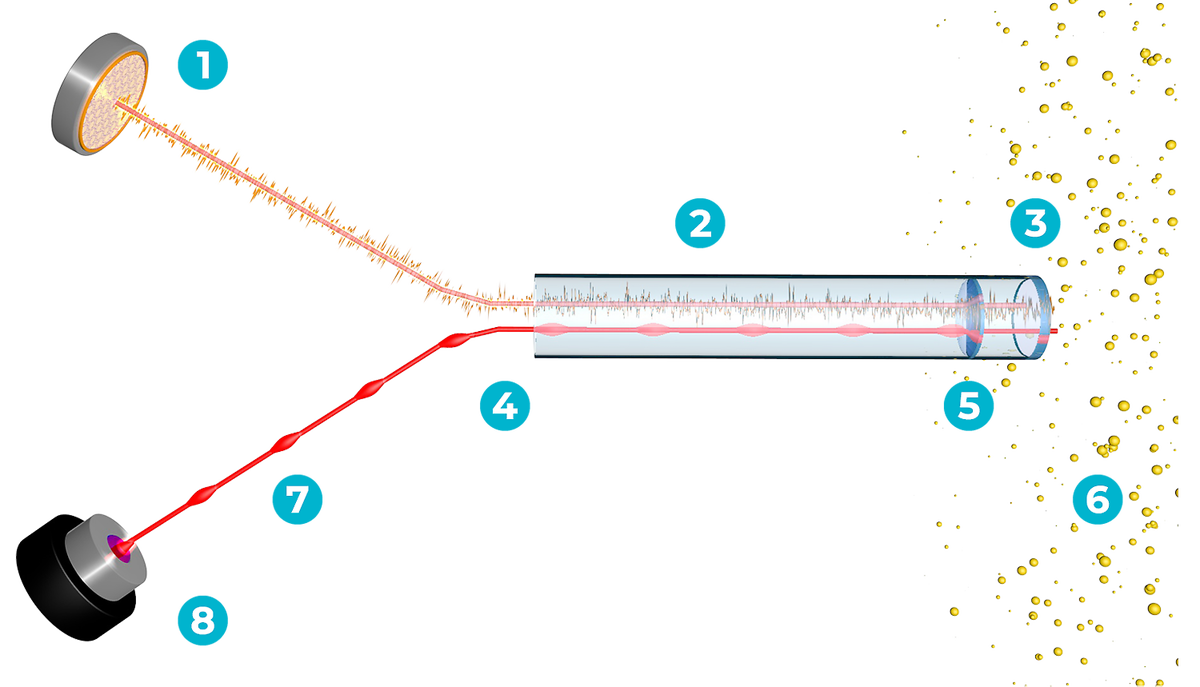
Function Principle
The zeta potential and molecular weight can also be measured with the SZ-100. Thanks to the special design of the measurement optics, sample concentrations can vary from a few ppm to 40 Vol%. The intuitive software guarantees the rapid and reliable characterization of nano materials.
The SZ-100 brochure contains detailed information on the function principle.
Subject to technical modifications and errors
For other countries please find your local contact at horiba-particle.com.